
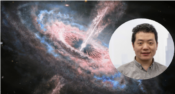
 Yongda Zhu Ph.D: post-doctoral research Associate; James Webb Space Telescope znIIR Cam & MIRI Teams, Stewart Observatory, University of Arizona
Monday, April 13, 2026, 3:00-4:00 pm, Koffler Great Room at ASA and zoom
Unlike the Hubble Space Telescope which orbits the Earth, the James Webb Space Telescope (JWST), roughly 1 million miles away on the “nightside” of Earth, orbits the Sun while following a specific path. It is transforming our view of the early universe, revealing galaxies and black holes in unprecedented detail. In this talk, Dr. Jongda Zhu will discuss how astronomers use JWST to study some of the earliest supermassive black holes and ask whether they can influence, or even suppress, the growth of the galaxies that host them and the galaxies around them. He will introduce the basic ideas behind galaxy evolution, explain what makes JWST such a powerful new tool, and share recent discoveries that are reshaping our understanding of how black holes and galaxies grew together in the first billion years after the Big Bang.